Monday, April 20, 2015

Making the Shift from Raising Awareness to Raising Healthy Kids
http://ifttt.com/images/no_image_card.png Our healthcare system is criticized for a greater focus on treating versus preventing disease and for not always supporting behavioral changes that lead to positive health outcomes. But many diseases, such as type II diabetes, heart disease, overweight and obesity, are complex societal issues, which many facets of society, and not just the healthcare system, play a role in preventing. Furthermore, just as the problems that have led to poor nutrition, physical inactivity, and overweight among our youth are multifaceted, so too are the solutions.
This week, schools around the country celebrate Every Kid Healthy Week, a moment during the school year to celebrate their health and wellness accomplishments achieved through nutrition and physical activity initiatives. We have come a long way since 2001 when I was Surgeon General and we issued a call to action to Prevent and Decrease Overweight and Obesity. The growing epidemic required a seismic shift in thinking about how to prevent childhood obesity, keep children from becoming overweight adults and teach lifelong habits necessary to promote health.
We identified schools as a key setting to address this national health challenge, given children spend the most time outside the home there, more than 1,200 hours per year.
Schools provide many opportunities, and share a responsibility, to help children learn healthy habits, if for no other reason than because such habits are intrinsically linked to academic success. Everyone from teachers to principals to food service professionals is positioned to teach and model healthy eating and physical activity for students. After all, schools are where children learn, and they need every advantage to do so.
Progress has been made, but schools remain a critical battle ground. Today 30 million children rely on school meals, and the nutritional quality of those meals has improved but remains an issue of debate. In many communities, the culture of unhealthy snacking has permeated schools, providing new challenges. Daily physical education, too often threatened by budget cuts, can provide a foundation for helping youth meet daily physical activity recommendations; yet daily PE is a reality in only four percent of our elementary schools.
When Action for Healthy Kids issued its first Learning Connection report in 2004, there was a growing body of research that showed associations between decreased academic performance and poor nutrition, inactivity, and overweight. The report focused on the problem, grounding society in the causes of childhood obesity and the cost to children's health and schools' bottom lines. It included nascent examples of schools working to combat the trend, but these were a drop in the bucket, as the movement for change was just beginning.
Today, the evidence linking good nutrition and physical activity with learning, cognition, behavior and academic performance is stronger than ever, detailed in an updated Learning Connection in 2013. We also have countless examples of success and best practices from schools across the country. Campbell Ridge Elementary School in Alexandria, Kentucky went from 69th to 86th percentile for state test scores following a rigorous implementation of the school's wellness policy. Toledo Public Schools in Ohio took a collaborative approach with local advocates and the teacher's union to implement a grab-and-go breakfast program, increasing school breakfast participation by 35 percent over three years. In Gulfport, Mississippi, 28th Street Elementary School transformed its school from one that offered candy rewards and once-weekly physical education classes to one that successfully introduced students to new foods in the cafeteria, holds interactive monthly healthy food tastes tests, and now ensures 60 minutes of physical activity per day.
Adding to the burgeoning research that supports the case for nutrition and physical activity in schools, obesity rate increases across several age categories remain high but appear to be slowing. The prevalence of obesity among children aged 2 to 5 years decreased significantly from 13.9 percent in 2003-2004 to 8.4 percent in 2011-2012. This improvement among our youngest children demonstrates the impact we can have when we intervene at an early age, especially among lower-income children and families. It also shows there is no silver bullet or quick fix to childhood obesity and related chronic diseases.
We have also come to realize that poor health among our youth is not an issue that can be addressed by one organization or entity alone. The gains being made across the country come not from one school or organization, but from a collective effort to impact change. Let's accelerate the movement that began more than a decade ago, no longer just to raise awareness of the threats childhood obesity poses but to shout from the rooftops about the progress being made, the many collaborative efforts, and the steps that schools, parents, communities, and the public and private sectors must continue to make in order to safeguard the health of current and future generations and indeed of our nation.
This blog post is part of a series produced by The Huffington Post and Action for Healthy Kids, in conjunction with Every Kid Healthy Week taking place in schools nationwide, April 19-25, 2015. For more information about Every Kid Healthy, email info@everykidhealthy.org.
from http://www.huffingtonpost.com/healthy-living/
This week, schools around the country celebrate Every Kid Healthy Week, a moment during the school year to celebrate their health and wellness accomplishments achieved through nutrition and physical activity initiatives. We have come a long way since 2001 when I was Surgeon General and we issued a call to action to Prevent and Decrease Overweight and Obesity. The growing epidemic required a seismic shift in thinking about how to prevent childhood obesity, keep children from becoming overweight adults and teach lifelong habits necessary to promote health.
We identified schools as a key setting to address this national health challenge, given children spend the most time outside the home there, more than 1,200 hours per year.
Schools provide many opportunities, and share a responsibility, to help children learn healthy habits, if for no other reason than because such habits are intrinsically linked to academic success. Everyone from teachers to principals to food service professionals is positioned to teach and model healthy eating and physical activity for students. After all, schools are where children learn, and they need every advantage to do so.
Progress has been made, but schools remain a critical battle ground. Today 30 million children rely on school meals, and the nutritional quality of those meals has improved but remains an issue of debate. In many communities, the culture of unhealthy snacking has permeated schools, providing new challenges. Daily physical education, too often threatened by budget cuts, can provide a foundation for helping youth meet daily physical activity recommendations; yet daily PE is a reality in only four percent of our elementary schools.
When Action for Healthy Kids issued its first Learning Connection report in 2004, there was a growing body of research that showed associations between decreased academic performance and poor nutrition, inactivity, and overweight. The report focused on the problem, grounding society in the causes of childhood obesity and the cost to children's health and schools' bottom lines. It included nascent examples of schools working to combat the trend, but these were a drop in the bucket, as the movement for change was just beginning.
Today, the evidence linking good nutrition and physical activity with learning, cognition, behavior and academic performance is stronger than ever, detailed in an updated Learning Connection in 2013. We also have countless examples of success and best practices from schools across the country. Campbell Ridge Elementary School in Alexandria, Kentucky went from 69th to 86th percentile for state test scores following a rigorous implementation of the school's wellness policy. Toledo Public Schools in Ohio took a collaborative approach with local advocates and the teacher's union to implement a grab-and-go breakfast program, increasing school breakfast participation by 35 percent over three years. In Gulfport, Mississippi, 28th Street Elementary School transformed its school from one that offered candy rewards and once-weekly physical education classes to one that successfully introduced students to new foods in the cafeteria, holds interactive monthly healthy food tastes tests, and now ensures 60 minutes of physical activity per day.
Adding to the burgeoning research that supports the case for nutrition and physical activity in schools, obesity rate increases across several age categories remain high but appear to be slowing. The prevalence of obesity among children aged 2 to 5 years decreased significantly from 13.9 percent in 2003-2004 to 8.4 percent in 2011-2012. This improvement among our youngest children demonstrates the impact we can have when we intervene at an early age, especially among lower-income children and families. It also shows there is no silver bullet or quick fix to childhood obesity and related chronic diseases.
We have also come to realize that poor health among our youth is not an issue that can be addressed by one organization or entity alone. The gains being made across the country come not from one school or organization, but from a collective effort to impact change. Let's accelerate the movement that began more than a decade ago, no longer just to raise awareness of the threats childhood obesity poses but to shout from the rooftops about the progress being made, the many collaborative efforts, and the steps that schools, parents, communities, and the public and private sectors must continue to make in order to safeguard the health of current and future generations and indeed of our nation.
This blog post is part of a series produced by The Huffington Post and Action for Healthy Kids, in conjunction with Every Kid Healthy Week taking place in schools nationwide, April 19-25, 2015. For more information about Every Kid Healthy, email info@everykidhealthy.org.
-- This feed and its contents are the property of The Huffington Post, and use is subject to our terms. It may be used for personal consumption, but may not be distributed on a website.
from http://www.huffingtonpost.com/healthy-living/
These Campus Activists Are Pushing Back On Abortion Stigma One Sticker At A Time
http://ifttt.com/images/no_image_card.png One in 3 American women will have an abortion in her lifetime. And yet, the issue is undeniably one of the most stigmatized, politically charged ones in America. Young college activists across the country, however, are using their individual stories to make this politicized topic a personal issue.
from http://www.huffingtonpost.com/healthy-living/
-- This feed and its contents are the property of The Huffington Post, and use is subject to our terms. It may be used for personal consumption, but may not be distributed on a website.
from http://www.huffingtonpost.com/healthy-living/
Is Facebook Making Us Stupid, Boring and Insecure?
http://ifttt.com/images/no_image_card.png In a University of Maryland study, students were asked to go without digital tools for 24 hours. The result? Symptoms of withdrawal. Students reported: "I began going crazy." "I went into absolute panic mode." "I felt paralyzed." "I ... stared blankly. I had nothing to do." "Unplugging ... felt like turning off a life-support system." "I felt dead."
Which made me think a little more closely about my technology use, primarily Facebook, which has been a favorite in the last few years. And I started to wonder, "Is this really serving me?"
Because the truth is, I could see a little of myself in those uneasy-feeling students. Maybe it was that urge to scroll, view, like, and update I was having oh so often. Maybe it was the weird feeling that something didn't feel right, or real, or even healthy about it all. It was time for a personal check-in.
So, harmful or benign, what is it?
When I started to take an honest look at my newsfeed, I noticed that besides a few interesting articles shared, fundraisers promoted, or words of encouragement from a few "friends," the majority of what "feeds" us is grandstanding, approval seeking and ego. Been there, done that. Takes one to know one, as they say.
And the truth is, the more I stand back and just notice, myself, and others, the more I wonder, "What's real?"
Our news feeds are also scattered with an overwhelming amount of stimulation in the form of hundreds of status updates, links to follow, ads to click on and a separate streaming feed of other people's likes and comments.
And all this hyper-stimulation, all this voyeuristic viewing of others, all this posting of our personal moments in search of likes, favorites, and such, has its impacts.
Our social media is dumbing us down
I do recall a time before Facebook and mass immersion into short bites of information associated with chaotic and inattentive thinking that is rewiring the very synapses of our brains, that we actually read books, for learning and for fun.
In university we debated arguments based on research from stacks of these relics. Books with pages to turn, corners to fold, words to underline and paragraphs that we would flip back and forwards to in an attempt to find that one thought we wanted to quote for a paper.
It didn't seem unusual, then, to focus our attention on an issue long enough to see past the headline. The whole point was to try to understand the complexity of what was in front of us.
Contrast this with our newsfeed, full of short bites and quips. Post anything too long and we lose our audience's shortened attention spans.
We're boring ourselves to death
At the mercy of cookies that follow our every click and algorithms designed to serve us more of what we already like, we are destined to believe even more of what we already think we know. This is the equivalent of surrounding ourselves in a cloistered bubble of homogeneity, conformity and group think, which spells boredom.
It becomes difficult to expand our understanding, awareness and aptitudes if we are only being served up more of what we already believe and agree with.
Conversely, plunging ourselves into the unknown and deepening our learning by extending ourselves into that Vygotzkian zone of proximal development where we have an underpinning of knowledge but still have to awkwardly leap up to that next level, expands our awareness and brings novelty and challenge to our lives. This is just one delightful and expansive antidote for boring and dull.
I don't feel so great
I was running with a friend of mine, who is a top athlete, turned trainer. She said to me, "When I'm training people for marathons I teach them that the moment they notice the other person and look over their shoulder, they've lost it."
What my friend was talking about is comparison. Gone awry, it messes with our minds, our emotions, our confidence, and has us second guess even our well-developed abilities.
In a world of 7 billion people where we rub shoulders with at least a handful of other humans, there is bound to be comparison. We watch how others live, love, serve, achieve, play and more. And some of those people just give us something amazing to aspire to.
But here's the problem with Facebook and social media streams. We're comparing ourselves to the one percent of people's lives they actually want to show us. It's kind of like watching the replay of a hockey game, where only the goals are highlighted. It's not the whole picture.
Besides, that snippet of something we do see, that one percent, is it something real? Or is something photoshopped and filtered into near perfection? Real life manufactured to look like real life.
And about all those moments, those status updates, those goals in net we're jealously viewing, drooling and stewing over, remember this. We weren't beside that person the 99 percent of the time they spent getting there, screwing up and failing as humans are apt to.
Contrast that with the live person beside us in real time. We compare ourselves, imperfect as we are, to the imperfect human they are.
So why do we do all this dumbing down, boring ourselves to death, and provoking of our own insecurity? On balance, it certainly doesn't feel good, does it? And it seems like it does the opposite of improve our lives, when we could be climbing a mountain, swimming in a lake, cuddling up with a book or huddling over chai with friends.
So why are we sitting on our computers, watching other people live their lives?
For one, we're afraid of being left out. Without our continuous availability of responsive liking, commenting or sharing we may no longer belong to the group or have a presence.
We have a human need to belong and in the absence of real community, the one just outside our front doors that we shuttle past with little acknowledgement, we'll take a filler, even if it may mean tricking our brains into believing we are authentically "connected with friends."
But that's not the only reason.
Why do we keep indulging in any addiction that damages our lives?
For the same reason we gamble again, take another drink, have another cigarette, or drain the last dollars from our bank account for a pair of Gucci strappy sandals.
Because we get a hit from it.
Yes, that's good old dopamine, our pleasure chemical, and it feels juicy. The reward centers of our brain are lighting up, and like Pavlovian trained mammals we're continually throwing ourselves at the mercy of these rewards despite the gravity of the consequences.
Some of the impacts of Internet addiction include: cybersexual addiction, where users are involved in online pornography and role play chat-rooms; online affairs and relationships that replace or cause discord in personal relationships; Internet gambling and purchasing resulting in significant loss of money; and excessive web surfing and searching associated with obsessive compulsive tendencies and reduced work productivity. Addicted Internet users may feel preoccupied with the Internet, make unsuccessful attempts to control or cut back use, and become restless, moody and depressed when trying to cut back, lie about the extent of their use, jeopardize a relationship, job, or educational opportunity due to Internet use, or rely on the Internet to relieve a dysphoric mood.
As neuroscientist Frances Jensen notes, "dopamine can be triggered just as easily by the release of the latest iPhone as by alcohol, pot, sex, or a fast car. In some ways, technology is a drug."
So you be judge, and notice yourself. How you connect. How you disconnect. How much is too much? With the limited hours of life time available to each of us, are we spending them in a way that aligns with our highest aptitudes, greatest desires, and optimum health and vitality?
Because the answer to whether our social media use is harmful or benign might just lie in the question we need to ask ourselves:
"How good do I really want to feel?"
from http://www.huffingtonpost.com/healthy-living/
Which made me think a little more closely about my technology use, primarily Facebook, which has been a favorite in the last few years. And I started to wonder, "Is this really serving me?"
Because the truth is, I could see a little of myself in those uneasy-feeling students. Maybe it was that urge to scroll, view, like, and update I was having oh so often. Maybe it was the weird feeling that something didn't feel right, or real, or even healthy about it all. It was time for a personal check-in.
So, harmful or benign, what is it?
When I started to take an honest look at my newsfeed, I noticed that besides a few interesting articles shared, fundraisers promoted, or words of encouragement from a few "friends," the majority of what "feeds" us is grandstanding, approval seeking and ego. Been there, done that. Takes one to know one, as they say.
And the truth is, the more I stand back and just notice, myself, and others, the more I wonder, "What's real?"
Our news feeds are also scattered with an overwhelming amount of stimulation in the form of hundreds of status updates, links to follow, ads to click on and a separate streaming feed of other people's likes and comments.
And all this hyper-stimulation, all this voyeuristic viewing of others, all this posting of our personal moments in search of likes, favorites, and such, has its impacts.
Our social media is dumbing us down
I do recall a time before Facebook and mass immersion into short bites of information associated with chaotic and inattentive thinking that is rewiring the very synapses of our brains, that we actually read books, for learning and for fun.
In university we debated arguments based on research from stacks of these relics. Books with pages to turn, corners to fold, words to underline and paragraphs that we would flip back and forwards to in an attempt to find that one thought we wanted to quote for a paper.
It didn't seem unusual, then, to focus our attention on an issue long enough to see past the headline. The whole point was to try to understand the complexity of what was in front of us.
Contrast this with our newsfeed, full of short bites and quips. Post anything too long and we lose our audience's shortened attention spans.
We're boring ourselves to death
At the mercy of cookies that follow our every click and algorithms designed to serve us more of what we already like, we are destined to believe even more of what we already think we know. This is the equivalent of surrounding ourselves in a cloistered bubble of homogeneity, conformity and group think, which spells boredom.
It becomes difficult to expand our understanding, awareness and aptitudes if we are only being served up more of what we already believe and agree with.
Conversely, plunging ourselves into the unknown and deepening our learning by extending ourselves into that Vygotzkian zone of proximal development where we have an underpinning of knowledge but still have to awkwardly leap up to that next level, expands our awareness and brings novelty and challenge to our lives. This is just one delightful and expansive antidote for boring and dull.
I don't feel so great
I was running with a friend of mine, who is a top athlete, turned trainer. She said to me, "When I'm training people for marathons I teach them that the moment they notice the other person and look over their shoulder, they've lost it."
What my friend was talking about is comparison. Gone awry, it messes with our minds, our emotions, our confidence, and has us second guess even our well-developed abilities.
In a world of 7 billion people where we rub shoulders with at least a handful of other humans, there is bound to be comparison. We watch how others live, love, serve, achieve, play and more. And some of those people just give us something amazing to aspire to.
But here's the problem with Facebook and social media streams. We're comparing ourselves to the one percent of people's lives they actually want to show us. It's kind of like watching the replay of a hockey game, where only the goals are highlighted. It's not the whole picture.
Besides, that snippet of something we do see, that one percent, is it something real? Or is something photoshopped and filtered into near perfection? Real life manufactured to look like real life.
And about all those moments, those status updates, those goals in net we're jealously viewing, drooling and stewing over, remember this. We weren't beside that person the 99 percent of the time they spent getting there, screwing up and failing as humans are apt to.
Contrast that with the live person beside us in real time. We compare ourselves, imperfect as we are, to the imperfect human they are.
So why do we do all this dumbing down, boring ourselves to death, and provoking of our own insecurity? On balance, it certainly doesn't feel good, does it? And it seems like it does the opposite of improve our lives, when we could be climbing a mountain, swimming in a lake, cuddling up with a book or huddling over chai with friends.
So why are we sitting on our computers, watching other people live their lives?
For one, we're afraid of being left out. Without our continuous availability of responsive liking, commenting or sharing we may no longer belong to the group or have a presence.
We have a human need to belong and in the absence of real community, the one just outside our front doors that we shuttle past with little acknowledgement, we'll take a filler, even if it may mean tricking our brains into believing we are authentically "connected with friends."
But that's not the only reason.
Why do we keep indulging in any addiction that damages our lives?
For the same reason we gamble again, take another drink, have another cigarette, or drain the last dollars from our bank account for a pair of Gucci strappy sandals.
Because we get a hit from it.
Yes, that's good old dopamine, our pleasure chemical, and it feels juicy. The reward centers of our brain are lighting up, and like Pavlovian trained mammals we're continually throwing ourselves at the mercy of these rewards despite the gravity of the consequences.
Some of the impacts of Internet addiction include: cybersexual addiction, where users are involved in online pornography and role play chat-rooms; online affairs and relationships that replace or cause discord in personal relationships; Internet gambling and purchasing resulting in significant loss of money; and excessive web surfing and searching associated with obsessive compulsive tendencies and reduced work productivity. Addicted Internet users may feel preoccupied with the Internet, make unsuccessful attempts to control or cut back use, and become restless, moody and depressed when trying to cut back, lie about the extent of their use, jeopardize a relationship, job, or educational opportunity due to Internet use, or rely on the Internet to relieve a dysphoric mood.
As neuroscientist Frances Jensen notes, "dopamine can be triggered just as easily by the release of the latest iPhone as by alcohol, pot, sex, or a fast car. In some ways, technology is a drug."
So you be judge, and notice yourself. How you connect. How you disconnect. How much is too much? With the limited hours of life time available to each of us, are we spending them in a way that aligns with our highest aptitudes, greatest desires, and optimum health and vitality?
Because the answer to whether our social media use is harmful or benign might just lie in the question we need to ask ourselves:
"How good do I really want to feel?"
-- This feed and its contents are the property of The Huffington Post, and use is subject to our terms. It may be used for personal consumption, but may not be distributed on a website.
from http://www.huffingtonpost.com/healthy-living/
7 In-Seat Exercises That Make Flying Less Painful
http://ifttt.com/images/no_image_card.png
from http://www.huffingtonpost.com/healthy-living/
-- This feed and its contents are the property of The Huffington Post, and use is subject to our terms. It may be used for personal consumption, but may not be distributed on a website.
from http://www.huffingtonpost.com/healthy-living/
Christine's Story Emphasizes Power of Tedy's Team
http://images.huffingtonpost.com/2015-04-17-1429298756-3626326-TedysTeamlogo-thumb.jpg Today is Patriots' Day, a joyous occasion for everyone in Boston and across New England.
While the sorrow of the Boston Marathon bombing in 2013 remains scarred in our memories, the history behind this holiday -- it commemorates the start of the Revolutionary War in 1775 -- reminds us that the good guys always prevail.
And, today, I'd like to shine this spotlight on a very special group of good guys.
 They go by the name of Tedy's Team, and this is their 10th year of running the Boston Marathon.
Tedy is former New England Patriots star Tedy Bruschi, whose NFL career was interrupted by a stroke in 2005. He was 31 and a few weeks removed from being crowned a Super Bowl champion.
Upon his recovery, Bruschi worked with the American Stroke Association to fight our nation's No. 5 killer. His team has raised more than $3.5 million, funding research and increasing awareness both of the warning signs and of the fact stroke is beatable, treatable and largely preventable.
Joining Tedy's Team takes more than signing up or making a donation. It involves an application and a key requirement: Being a stroke survivor or having a loved one who is. Spots on the team are cherished, mainly because they come with a unique kinship.
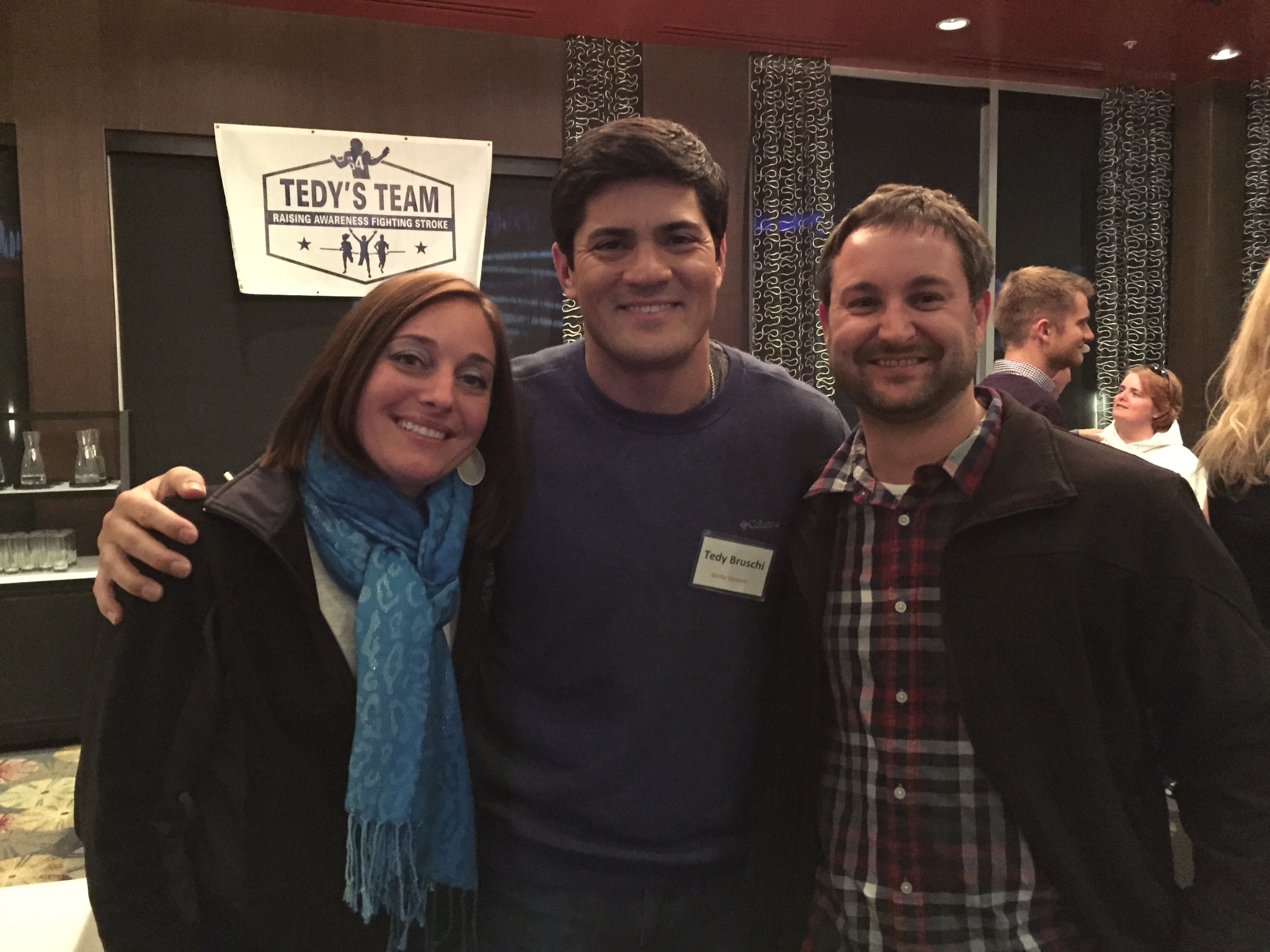
"It is the best thing that's ever happened to me on so many levels," said Christine Duval, who is preparing for her third Boston Marathon as part of the squad. "It's the first time I've been surrounded by people who get it. They know what stroke does to people, what survivors and their families had to go through to get where they are."
Sadly, Duval knows it all too well.

Christine (left) and Tedy Bruschi (middle)
----
On Oct. 7, 1997, Duval was a junior in high school when her dad, Joseph, suffered a massive stroke.
On Nov. 27, 2003, she was in her second year of nursing school when her mother, Beverly, suffered a massive stroke.
Each lived, yet neither would ever be the same. The strokes robbed their personalities, leaving both unable to communicate.
"I look at my mom in the nursing home and I don't see my mom anymore. I look at my dad and I don't see my dad anymore," Christine said. "Both of my parents are shadows of who they were -- you can see the outlines, but you can't see their faces. I think that's what makes it even harder."
Christine grew up fast after her dad's stroke, faster still when she was thrust into being the sole caregiver to two parents at age 23.
She left college in Denver and moved back to Fitchburg, Massachusetts. Once things stabilized, she began working at her aunt and uncle's sporting goods store; a few years later, she bought it. She lives with her father; Mom is a short drive away.
"I've yet to meet anybody locked in my shoes, with both parents going through this," she said. "I hope that I'm a 1-in-a-bajillion case."
---
 Joseph Duval was fighting in Vietnam when his father started Greenville Hardware Store in Greenville, New Hampshire. He took over upon returning home in 1969, then married Beverly in 1971. Christine arrived in 1980.
Joseph and Beverly were a happy, hard-working couple. She was gregarious, quick to befriend strangers; he was more shy, quiet... sometimes even grumpy. An active lifestyle kept them fit, and they were always in good health; neither smoked nor drank.
They were always together, working in the store Monday through Saturday, then spending Sundays tinkering with projects at home.
 In warmer months, they enjoyed their swimming pool. A few times every summer, they'd pile into their motor home and spend a weekend in Hancock, New Hampshire, or perhaps Maine. During winters, Beverly and Christine enjoyed skiing.
The fun ended with Joseph's stroke. Technically, it was a cerebral hemorrhage; a weak blood vessel in his brain gave out.
Christine traded all her extracurricular activities for a single one: visiting Dad in the hospital. She also supported her mom ("We were a team; we had to be") as Beverly pursued every therapy possible to help Joseph recover.
"He became pretty independent -- he can bathe himself, go to the bathroom by himself, feed himself," Christine said. "But nothing, nothing, nothing brought his speech back."
As Joseph improved, Christine went to an arts college in Boston, then moved to Colorado. She worked for a year, then began studying nursing, inspired by those who'd cared for her father.
Her parents visited for Thanksgiving, and the next day they all went to The Home Depot to buy liners for her kitchen drawers. Beverly had just finished joking with an employee when the cart she was pushing rolled away and she fell. What looked like a seizure turned out to be another devastating stroke.
"My dad was crying; he couldn't understand what was going on," Christine said. "I was more scared than I've ever been in life."
An aneurysm ruptured in Beverly's brain. She underwent a procedure to clamp the damage, and one overly optimistic doctor suggested she'd be running a marathon in a few months.
Instead, she spent a month in a coma. It took five years before she even fed herself.
"My mom saw everything my dad went through and how hard he worked to get where he was," Christine said. "My theory is, deep down she knew how hard it was going to be and that she still wouldn't be herself at the end."
---
Thrust into a life she'd never expected, Christine hardly had time to think about herself.
Then one day she was fitting ski boots for a nice young couple with two adorable kids.
The husband mentioned that he ran on Tedy's Team and she asked about what that was. When he explained the stroke connection, "my jaw dropped," Christine said. She was even more stunned to learn that the cute little girl running around had a stroke in utero that wasn't diagnosed until she was a few months old.
"Seeing this little girl run around totally normal gave me hope that somebody can have a stroke and a normal life," she said. "I sent an email, filled out the application and that October I got the call that I was on the team. My life changed instantaneously."
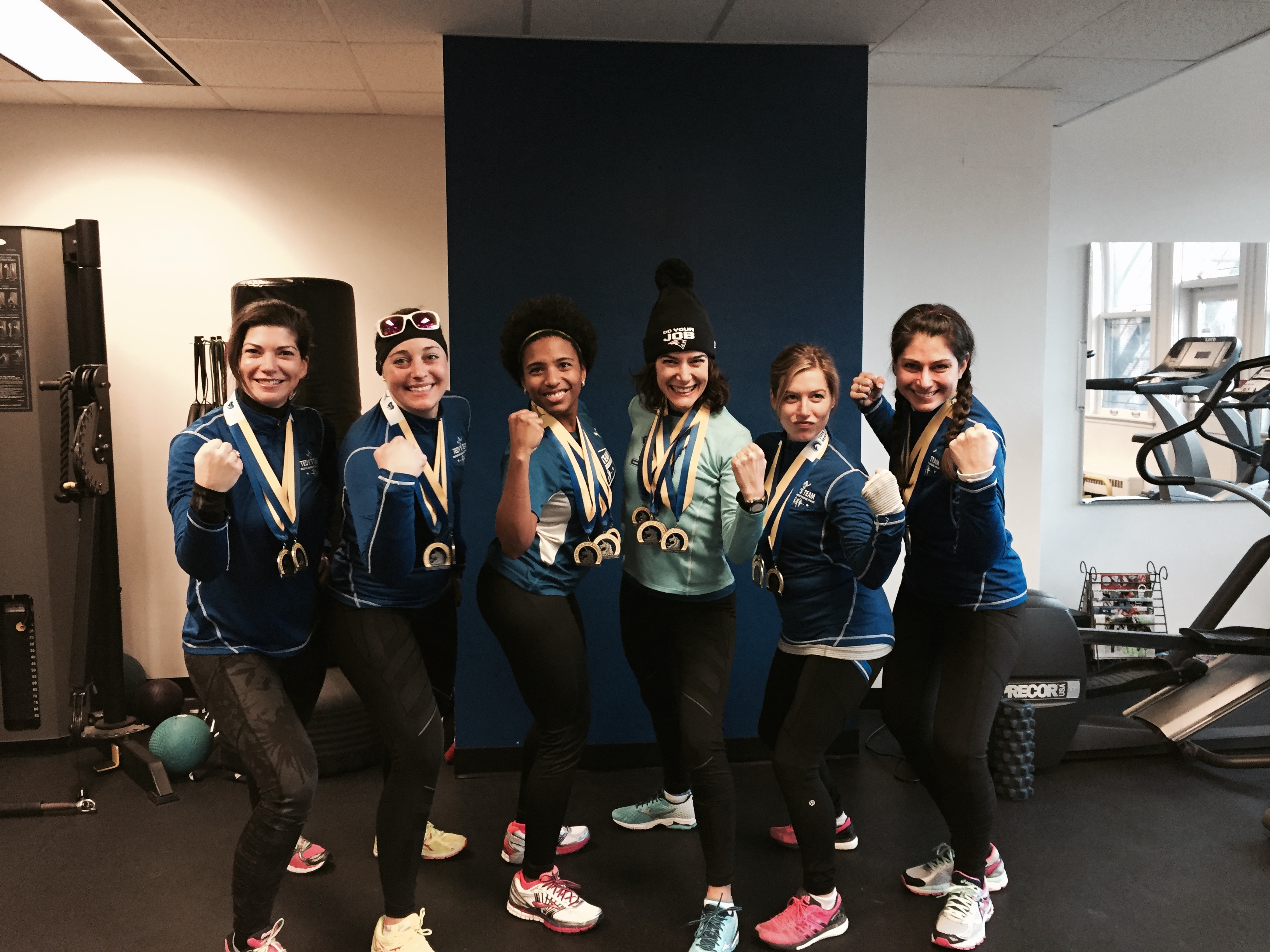
 Christine found the support group she didn't know she needed.
"I can't imagine my life without them now and I can't imagine what I did before them," she said. "When things get tough with my dad or don't go right with Mom, they're the first people I contact. When I'm scared or hurting, they respond instantaneously."
The support extends to running, such as in last year's marathon, when Christine and two teammates suffered dehydration around the famous Heartbreak Hill. They encouraged each other to reach the finish line. (In her first marathon with Tedy's Team, Christine was less than a mile from the finish when the bombs went off. She didn't hear it, but to this day hearing a helicopter reminds her of all the choppers that surrounded the finish line.)
---
Joseph spends most days at home, with Christine usually checking in around lunchtime. When the weather is good, he sits outside and waves at everyone who passes by. The stroke turned him into a bit of an extrovert; "He has more friends in the neighborhood than I do," Christine said, laughing.
Beverly uses a wheelchair. The inactivity, plus the medicines she takes, have caused her to gain a lot of weight. Her personality also has reversed, her fire for life somewhat extinguished.
For each of them, the best part of their week is being together.
"She just glows when he's around," Christine said. "She'll hum to him and he'll mumble stuff back. They somehow have this conversation. It's completely crazy, but they know what each other is saying."
As for Christine, her boyfriend, Tim Pelletier; her dog, Deco; her pals on Tedy's Team; her other friends and her family all keep her going.
She obviously has a family history of stroke to worry about, and she does -- every headache leaves her "petrified that something's going to happen." But she refuses to be consumed by it.
"I love life," she said. "I'm not going to let something that may never happen stop me. Stroke is going to haunt me forever, but I'm going to let it get me down."

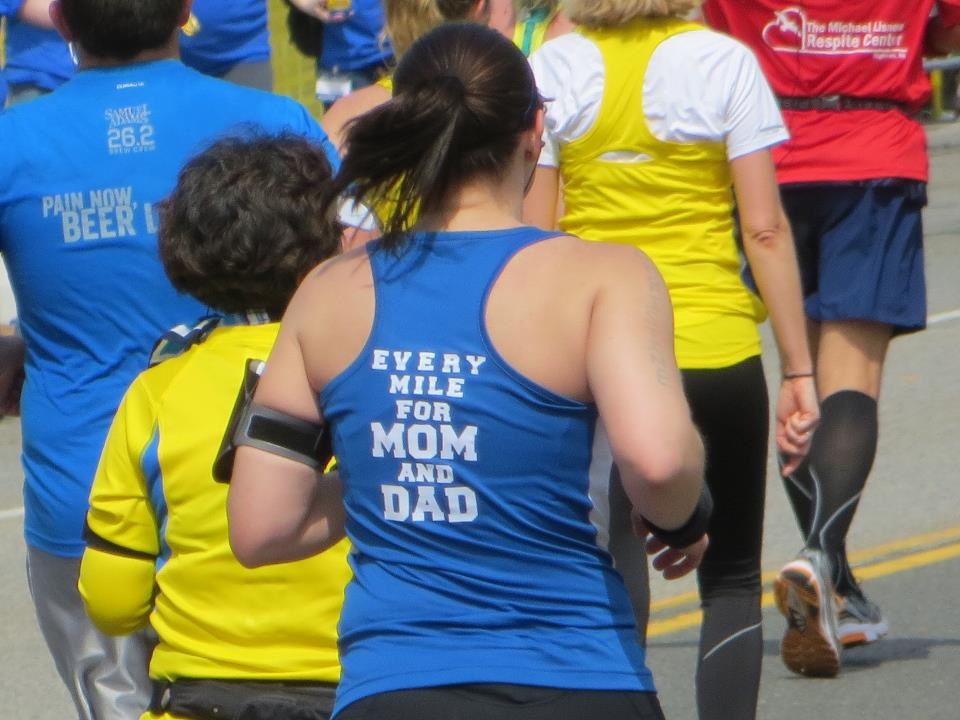
Christine wears her motivation on the back of her marathon jersey

from http://www.huffingtonpost.com/healthy-living/
While the sorrow of the Boston Marathon bombing in 2013 remains scarred in our memories, the history behind this holiday -- it commemorates the start of the Revolutionary War in 1775 -- reminds us that the good guys always prevail.
And, today, I'd like to shine this spotlight on a very special group of good guys.
 They go by the name of Tedy's Team, and this is their 10th year of running the Boston Marathon.
Tedy is former New England Patriots star Tedy Bruschi, whose NFL career was interrupted by a stroke in 2005. He was 31 and a few weeks removed from being crowned a Super Bowl champion.
Upon his recovery, Bruschi worked with the American Stroke Association to fight our nation's No. 5 killer. His team has raised more than $3.5 million, funding research and increasing awareness both of the warning signs and of the fact stroke is beatable, treatable and largely preventable.
Joining Tedy's Team takes more than signing up or making a donation. It involves an application and a key requirement: Being a stroke survivor or having a loved one who is. Spots on the team are cherished, mainly because they come with a unique kinship.
"It is the best thing that's ever happened to me on so many levels," said Christine Duval, who is preparing for her third Boston Marathon as part of the squad. "It's the first time I've been surrounded by people who get it. They know what stroke does to people, what survivors and their families had to go through to get where they are."
Sadly, Duval knows it all too well.
On Oct. 7, 1997, Duval was a junior in high school when her dad, Joseph, suffered a massive stroke.
On Nov. 27, 2003, she was in her second year of nursing school when her mother, Beverly, suffered a massive stroke.
Each lived, yet neither would ever be the same. The strokes robbed their personalities, leaving both unable to communicate.
"I look at my mom in the nursing home and I don't see my mom anymore. I look at my dad and I don't see my dad anymore," Christine said. "Both of my parents are shadows of who they were -- you can see the outlines, but you can't see their faces. I think that's what makes it even harder."
Christine grew up fast after her dad's stroke, faster still when she was thrust into being the sole caregiver to two parents at age 23.
She left college in Denver and moved back to Fitchburg, Massachusetts. Once things stabilized, she began working at her aunt and uncle's sporting goods store; a few years later, she bought it. She lives with her father; Mom is a short drive away.
"I've yet to meet anybody locked in my shoes, with both parents going through this," she said. "I hope that I'm a 1-in-a-bajillion case."
 Joseph Duval was fighting in Vietnam when his father started Greenville Hardware Store in Greenville, New Hampshire. He took over upon returning home in 1969, then married Beverly in 1971. Christine arrived in 1980.
Joseph and Beverly were a happy, hard-working couple. She was gregarious, quick to befriend strangers; he was more shy, quiet... sometimes even grumpy. An active lifestyle kept them fit, and they were always in good health; neither smoked nor drank.
They were always together, working in the store Monday through Saturday, then spending Sundays tinkering with projects at home.
 In warmer months, they enjoyed their swimming pool. A few times every summer, they'd pile into their motor home and spend a weekend in Hancock, New Hampshire, or perhaps Maine. During winters, Beverly and Christine enjoyed skiing.
The fun ended with Joseph's stroke. Technically, it was a cerebral hemorrhage; a weak blood vessel in his brain gave out.
Christine traded all her extracurricular activities for a single one: visiting Dad in the hospital. She also supported her mom ("We were a team; we had to be") as Beverly pursued every therapy possible to help Joseph recover.
"He became pretty independent -- he can bathe himself, go to the bathroom by himself, feed himself," Christine said. "But nothing, nothing, nothing brought his speech back."
As Joseph improved, Christine went to an arts college in Boston, then moved to Colorado. She worked for a year, then began studying nursing, inspired by those who'd cared for her father.
Her parents visited for Thanksgiving, and the next day they all went to The Home Depot to buy liners for her kitchen drawers. Beverly had just finished joking with an employee when the cart she was pushing rolled away and she fell. What looked like a seizure turned out to be another devastating stroke.
"My dad was crying; he couldn't understand what was going on," Christine said. "I was more scared than I've ever been in life."
An aneurysm ruptured in Beverly's brain. She underwent a procedure to clamp the damage, and one overly optimistic doctor suggested she'd be running a marathon in a few months.
Instead, she spent a month in a coma. It took five years before she even fed herself.
"My mom saw everything my dad went through and how hard he worked to get where he was," Christine said. "My theory is, deep down she knew how hard it was going to be and that she still wouldn't be herself at the end."
Thrust into a life she'd never expected, Christine hardly had time to think about herself.
Then one day she was fitting ski boots for a nice young couple with two adorable kids.
The husband mentioned that he ran on Tedy's Team and she asked about what that was. When he explained the stroke connection, "my jaw dropped," Christine said. She was even more stunned to learn that the cute little girl running around had a stroke in utero that wasn't diagnosed until she was a few months old.
"Seeing this little girl run around totally normal gave me hope that somebody can have a stroke and a normal life," she said. "I sent an email, filled out the application and that October I got the call that I was on the team. My life changed instantaneously."
 Christine found the support group she didn't know she needed.
"I can't imagine my life without them now and I can't imagine what I did before them," she said. "When things get tough with my dad or don't go right with Mom, they're the first people I contact. When I'm scared or hurting, they respond instantaneously."
The support extends to running, such as in last year's marathon, when Christine and two teammates suffered dehydration around the famous Heartbreak Hill. They encouraged each other to reach the finish line. (In her first marathon with Tedy's Team, Christine was less than a mile from the finish when the bombs went off. She didn't hear it, but to this day hearing a helicopter reminds her of all the choppers that surrounded the finish line.)
Joseph spends most days at home, with Christine usually checking in around lunchtime. When the weather is good, he sits outside and waves at everyone who passes by. The stroke turned him into a bit of an extrovert; "He has more friends in the neighborhood than I do," Christine said, laughing.
Beverly uses a wheelchair. The inactivity, plus the medicines she takes, have caused her to gain a lot of weight. Her personality also has reversed, her fire for life somewhat extinguished.
For each of them, the best part of their week is being together.
"She just glows when he's around," Christine said. "She'll hum to him and he'll mumble stuff back. They somehow have this conversation. It's completely crazy, but they know what each other is saying."
As for Christine, her boyfriend, Tim Pelletier; her dog, Deco; her pals on Tedy's Team; her other friends and her family all keep her going.
She obviously has a family history of stroke to worry about, and she does -- every headache leaves her "petrified that something's going to happen." But she refuses to be consumed by it.
"I love life," she said. "I'm not going to let something that may never happen stop me. Stroke is going to haunt me forever, but I'm going to let it get me down."

-- This feed and its contents are the property of The Huffington Post, and use is subject to our terms. It may be used for personal consumption, but may not be distributed on a website.
from http://www.huffingtonpost.com/healthy-living/
3 Secrets to Health Maintenance Success
http://www.mariasfarmcountrykitchen.com/wp-content/uploads/2015/04/Maintaining-Weight-Loss.jpg 
by guest blogger Pam Peeke, MD, MPH, FACP, best-selling author and expert on health, fitness, and nutrition
Let's say you're at a point in your wellness journey where you are gradually and proudly hitting critical milestones: You can briskly walk two miles without speed-dialing 911; you can zip up pants and jackets all the way (it's no longer mission impossible!); buttons are buttoning, not bulging; you take a healthy lunch to work instead of munching a mountain of pizza slices.
There's a thrill and excitement associated with each new experience. You look in the mirror and smile. You hop into great-looking clothes. You feel high with energy to live your dreams. You can't wait for the next rush of dopamine as you navigate another hurdle and triumph once again.
This is all terrific. The next challenge is to maintain these new behaviors and accomplishments. And there's the rub: You have to keep this going for the long term. Maintenance is the process of preserving, carrying on, and perpetuating your optimal health and wellness. The antonym for maintenance is neglect. To maintain, you ditch self-abandonment.
Achieving and maintaining that higher state of being are two different processes. People gear up for achievement, but are perplexed by maintenance. You see expensive, colorful, motivational Madison Avenue-level ads for starting the journey. But there aren't any for long-term maintenance because the initial thrill is gone. Reaching your big goal(s) is one experience. Maintaining your achievement requires a transition to a whole new mental focus--the practice of rituals and behaviors that support lifelong sustainable success.
Here are 3 secrets to success in maintaining your newfound wellness:
1. Celebrate, commit, and cement. It's imperative to celebrate milestones, and then to keep committing to staying the course in order to cement into place your new level of wellness. There are two critical times when you must practice these three c's:
2. Make more excitement. I don't know about you, but maintenance is nowhere near as exciting as embarking on a journey. In any new beginning, there's constant elation and bursts of joy with each success. You feel pride in your progress. You're surrounded by novelty as you discover you can walk/run that 5K, that you need a smaller size, that you feel more confident at work, and that your doctor is pleased with your normalized blood pressure, blood sugar, or cholesterol.
But what happens once you've reached your pinnacle of success? You wake up the next morning and...you've got to keep it going, minus all of the novelty. You're there. But what does that mean? Simply said, in order to stay there, you have to do the work to maintain your success.
You do your exercise, shop for and cook healthy foods, and you practice stress management. On the first go-around, it's novel and engaging. Keeping it going day after day means accepting these lifestyle behaviors as integral to your survival and absolutely nonnegotiable. They have to become a piece of you, transitioning from conscious to subconscious.
So to fan the fires of long-term commitment, create new forms of excitement. Build upon your successes. OK, you've been dutifully going to the gym and performing the same exercises. How about changing it up and constantly challenging yourself? Get a fitness professional to guide you. Push your own envelope. Tired of the same foods? Experiment with spices, herbs, ethnic blends, and new cooking techniques. Tired of your meditation? Try a new one. Add new mind-body techniques to your repertoire. Keep maintenance exciting by looking for ways to refine, hone, and expand on your new foundation for healthy living.
3. Stay vigilant. "I'm there!" you cry out as you hit your goal. With that achievement, it's easy to relax the determination, passion, focus, and discipline it took to reach that goal in the first place. "Now I've arrived. I can stop working at it!" Au contraire. The same behaviors that supported your successful attainment of your goal are the foundation for your continued success. If you loosen up and stop paying attention, your old self-destructive behaviors are just laying in wait. This doesn't mean you should be overly obsessive. It simply means you maintain a baseline amount of self-protective vigilance. Try not to drop your guard. Yes, you've done well to achieve your big goal. The reality is that to keep savoring that success, you have to stay mindful, in the present, and accountable for your behaviors.
It's like learning how to drive a car. In the beginning you are hypervigilant, for fear of having an accident. After years of driving, there's no more sitting on the edge of the driver's seat, death grip on the steering wheel. You're more relaxed and confident--but you never drop your vigilance.
When I think about maintenance, I cannot help but recall with a mile-wide smile, one of the most memorable quotes from Nora Ephron's book I Feel Bad about My Neck: And Other Thoughts on Being a Woman: "Maintenance is what you have to do just so you can walk out the door knowing that if you go to the market and bump into a guy who once rejected you, you won't have to hide behind a stack of canned food."
Nora is saying that there's just a minimum amount of maintenance you need in order to stay proud and successful. You don't have to get crazy and slip into perfectionism. Instead, just do what you have to do mentally, nutritionally, and physically to maintain that wonderful new wellness milestone. And you'll never need to hide behind stacks of canned food.
 Pamela Peeke, MD, MPH, FACP, is a Pew Scholar in nutrition and metabolism, assistant professor of medicine at the University of Maryland, and a fellow of the American College of Physicians. A triathlete and mountaineer, she is known as "the doc who walks the talk," living what she's learned as an expert in health, fitness, and nutrition. Her current research at the University of Maryland centers on the connection between meditation and overeating. She is the author of many best-selling books, including Fight Fat after Forty. Her newest book is the New York Times bestseller The Hunger Fix.
For more from Maria Rodale, visit www.mariasfarmcountrykitchen.com
from http://www.huffingtonpost.com/healthy-living/
by guest blogger Pam Peeke, MD, MPH, FACP, best-selling author and expert on health, fitness, and nutrition
Let's say you're at a point in your wellness journey where you are gradually and proudly hitting critical milestones: You can briskly walk two miles without speed-dialing 911; you can zip up pants and jackets all the way (it's no longer mission impossible!); buttons are buttoning, not bulging; you take a healthy lunch to work instead of munching a mountain of pizza slices.
There's a thrill and excitement associated with each new experience. You look in the mirror and smile. You hop into great-looking clothes. You feel high with energy to live your dreams. You can't wait for the next rush of dopamine as you navigate another hurdle and triumph once again.
This is all terrific. The next challenge is to maintain these new behaviors and accomplishments. And there's the rub: You have to keep this going for the long term. Maintenance is the process of preserving, carrying on, and perpetuating your optimal health and wellness. The antonym for maintenance is neglect. To maintain, you ditch self-abandonment.
Achieving and maintaining that higher state of being are two different processes. People gear up for achievement, but are perplexed by maintenance. You see expensive, colorful, motivational Madison Avenue-level ads for starting the journey. But there aren't any for long-term maintenance because the initial thrill is gone. Reaching your big goal(s) is one experience. Maintaining your achievement requires a transition to a whole new mental focus--the practice of rituals and behaviors that support lifelong sustainable success.
Here are 3 secrets to success in maintaining your newfound wellness:
1. Celebrate, commit, and cement. It's imperative to celebrate milestones, and then to keep committing to staying the course in order to cement into place your new level of wellness. There are two critical times when you must practice these three c's:
- The first occurs while you are on the road to achieving your big goal. As you reach each milestone, take a moment to celebrate and enjoy how good it feels and your sense of pride. Once the rush of success has passed, get solidly determined to hold onto that success. This means you're committing to the daily practice of the new behaviors that helped you reach this milestone. Beware any shortcut schemes to achieving any wellness goal because cutting corners robs you of the opportunity and time it takes to practice and hone your behavior. Get real and acknowledge you'll sometimes be slippin' and slidin' in your daily practices, but you'll still be progressing over time.
- The second critical time to remember the three c's is when you've finally achieved all or most of your overall goal. Now, if you've been practicing your new behaviors all along, maintaining your big goal becomes much easier to do. Recommit for the long run.
2. Make more excitement. I don't know about you, but maintenance is nowhere near as exciting as embarking on a journey. In any new beginning, there's constant elation and bursts of joy with each success. You feel pride in your progress. You're surrounded by novelty as you discover you can walk/run that 5K, that you need a smaller size, that you feel more confident at work, and that your doctor is pleased with your normalized blood pressure, blood sugar, or cholesterol.
But what happens once you've reached your pinnacle of success? You wake up the next morning and...you've got to keep it going, minus all of the novelty. You're there. But what does that mean? Simply said, in order to stay there, you have to do the work to maintain your success.
You do your exercise, shop for and cook healthy foods, and you practice stress management. On the first go-around, it's novel and engaging. Keeping it going day after day means accepting these lifestyle behaviors as integral to your survival and absolutely nonnegotiable. They have to become a piece of you, transitioning from conscious to subconscious.
So to fan the fires of long-term commitment, create new forms of excitement. Build upon your successes. OK, you've been dutifully going to the gym and performing the same exercises. How about changing it up and constantly challenging yourself? Get a fitness professional to guide you. Push your own envelope. Tired of the same foods? Experiment with spices, herbs, ethnic blends, and new cooking techniques. Tired of your meditation? Try a new one. Add new mind-body techniques to your repertoire. Keep maintenance exciting by looking for ways to refine, hone, and expand on your new foundation for healthy living.
3. Stay vigilant. "I'm there!" you cry out as you hit your goal. With that achievement, it's easy to relax the determination, passion, focus, and discipline it took to reach that goal in the first place. "Now I've arrived. I can stop working at it!" Au contraire. The same behaviors that supported your successful attainment of your goal are the foundation for your continued success. If you loosen up and stop paying attention, your old self-destructive behaviors are just laying in wait. This doesn't mean you should be overly obsessive. It simply means you maintain a baseline amount of self-protective vigilance. Try not to drop your guard. Yes, you've done well to achieve your big goal. The reality is that to keep savoring that success, you have to stay mindful, in the present, and accountable for your behaviors.
It's like learning how to drive a car. In the beginning you are hypervigilant, for fear of having an accident. After years of driving, there's no more sitting on the edge of the driver's seat, death grip on the steering wheel. You're more relaxed and confident--but you never drop your vigilance.
When I think about maintenance, I cannot help but recall with a mile-wide smile, one of the most memorable quotes from Nora Ephron's book I Feel Bad about My Neck: And Other Thoughts on Being a Woman: "Maintenance is what you have to do just so you can walk out the door knowing that if you go to the market and bump into a guy who once rejected you, you won't have to hide behind a stack of canned food."
Nora is saying that there's just a minimum amount of maintenance you need in order to stay proud and successful. You don't have to get crazy and slip into perfectionism. Instead, just do what you have to do mentally, nutritionally, and physically to maintain that wonderful new wellness milestone. And you'll never need to hide behind stacks of canned food.
Pamela Peeke, MD, MPH, FACP, is a Pew Scholar in nutrition and metabolism, assistant professor of medicine at the University of Maryland, and a fellow of the American College of Physicians. A triathlete and mountaineer, she is known as "the doc who walks the talk," living what she's learned as an expert in health, fitness, and nutrition. Her current research at the University of Maryland centers on the connection between meditation and overeating. She is the author of many best-selling books, including Fight Fat after Forty. Her newest book is the New York Times bestseller The Hunger Fix.For more from Maria Rodale, visit www.mariasfarmcountrykitchen.com
-- This feed and its contents are the property of The Huffington Post, and use is subject to our terms. It may be used for personal consumption, but may not be distributed on a website.
from http://www.huffingtonpost.com/healthy-living/
Subscribe to:
Posts (Atom)